Chiclayo Visit: Pope Leo Addresses Clergy and Students
The Pope returned to his former diocese in northern Peru to urge church leaders to act on synodality and warned university attendees about the risks of artificial intelligence.
By Alyssa Parker ·
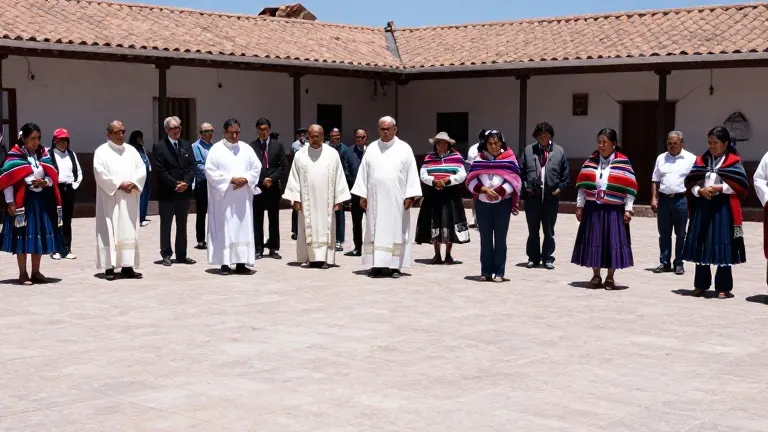
Pope Leo XIV visited Chiclayo, Peru, on November 13, 2026.
He returned to the city where he served as bishop from 2015 to 2023. The Pope held two afternoon meetings at local institutions. He spoke to church leaders at the Shrine of Our Lady of Peace and to university members at Santo Toribio de Mogrovejo Catholic University.
At the shrine, the Pope addressed bishops, priests, seminarians, and lay leaders. He urged them to move beyond talk of synodality and implement concrete changes. He stated that practicing synodality requires everyone to examine their attitudes, starting with pastors who serve the community.
He emphasized that authority in the Church must function as service. The Pope noted that lay participation is an expression of baptismal dignity, not a concession granted by hierarchy. Bishop Edinson Farfán Córdova of Chiclayo welcomed the Pope. The Bishop described the group as a Church alive in communion and mission. He prayed that the faithful would listen to one another with humility.
Before his speech, the Pope heard from a priest, a religious sister, and a layperson. A diocesan priest thanked the Pope for teaching clergy to avoid clericalism and to listen to the laity. Sister Rocía Carrasco Quintana of the Daughters of St. Mary of Providence said discernment with laypeople is a challenge for consecrated life. A laywoman from the Archdiocese of Piura described how synodality moved from theory to door-to-door ministry during three-day vigils.
The Pope said authentic communion values diversity rather than uniformity. He cited the Second Vatican Council document Gaudium et Spes. He reminded the audience that the Church shares the joys, hopes, griefs, and anxieties of humanity, especially the poor. He listed defending human dignity, accompanying families and migrants, and working for justice as requirements of the ecclesial mission, not optional tasks.
At the university, the Pope met with faculty, civil authorities, and students. Rector Patricia Campos Olazábal recalled his time as the university’s grand chancellor. She noted that students came to discern truth and false information in an era of artificial intelligence. The Pope warned against reducing higher education to job training for a competitive market. He said progress that ignores justice and worker dignity becomes a mechanism of oppression and exclusion.
He stated that science without a conscience ruins life, and technology without a soul does not improve it. The Pope warned against a technocratic paradigm that reduces reality to material data and values efficiency above all else. He invoked the memory of St. Turibius, who learned the local indigenous language and culture. He compared the deserts of Lambayeque to modern forms of moral and civic illiteracy that exclude the poor. He encouraged students to build a living relationship with God through prayer and study. He told professors to view their work as intellectual charity and to prioritize truth over opinion and justice over self-interest.