De la Espriella’s 100 days: Drone attacks rise as Colombia joins U.S. war on drugs
The new Colombian president closed peace talks, aligned with Washington, and approved a record budget despite a major earthquake.
By Alyssa Parker ·
Abelardo De la Espriella has completed his first 100 days as president of Colombia.
The conservative leader has prioritized military action against armed groups and a closer alliance with the United States. His administration also faces a severe fiscal challenge following a magnitude 7.4 earthquake. The disaster killed more than 330 people and left thousands displaced. The government estimates it will need approximately $9.5 billion to rebuild the affected areas.
De la Espriella, who had no prior public office experience, won the presidential runoff by a narrow margin. He campaigned on a platform to reverse the policies of his predecessor, Gustavo Petro. Upon taking office, he closed all peace negotiation tables that Petro had opened with illegal armed groups. The Congress approved a law allowing these groups to voluntarily submit to justice in exchange for reduced sentences.
The government has ordered airstrikes on camps belonging to the National Liberation Army and FARC dissidents. In one recent attack, De la Espriella signed the bomb before it was launched. He has also led surprise police operations in major cities, resulting in hundreds of arrests and seizures of weapons and drugs.
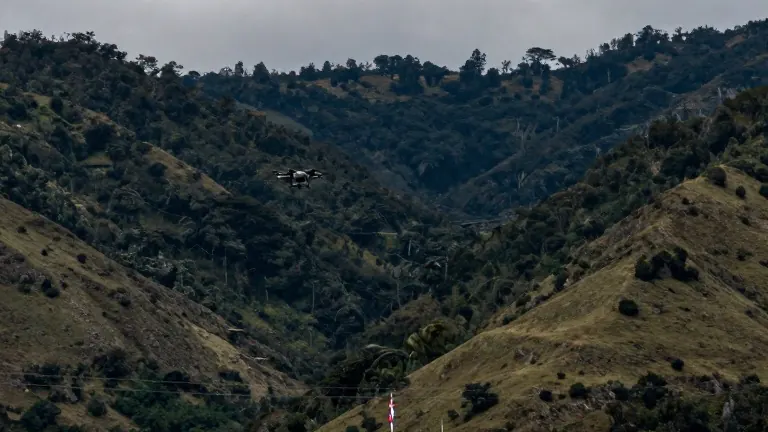
Gerson Arias, an analyst at the Ideas for Peace Foundation, noted that the presence of public forces has not increased significantly in disputed zones. He stated that illegal groups still control the territory and population. Arias argued that the goal of recovering territorial control is unrealistic in the short term. The foundation reported 323 drone attacks across the country from January to September. This represents a 95% increase compared to the same period in 2025. "We are seeing that the situation in terms of territory is not changing," Arias said.
Glaeldys González of the International Crisis Group described the city operations as a projection of authority. She said they create a public perception of strong leadership but require a long-term strategy to consolidate improvements.
In foreign policy, De la Espriella joined the U.S. Shield of the Americas, a strategy to combat drug trafficking. This move followed tensions between the previous administration and U.S. President Donald Trump. Trump and Secretary of State Marco Rubio have praised De la Espriella. David Castrillón Kerrigan, a researcher at Universidad Externado, said the alignment is partisan and personal. He warned that this close tie with Trump could have consequences for Colombia given the new Democratic majority in the U.S. Congress.
On the economy, De la Espriella promised to reduce the size of the state by up to 40%. Instead, the government approved a 2027 budget of approximately $201.14 billion, the highest in recent years. Marc Hofstetter, an economist at Universidad de los Andes, pointed out that the budget is higher than the previous government’s. The government has proposed an economic rescue law that includes a 15% reduction in the state and tax increases. Hofstetter warned that without new taxes, the government may be unable to meet its financial obligations within a few months.