Laramie civic center murals draw scrutiny
A building manager questions the historical accuracy of 1929 paintings depicting Indigenous people in the sky.
By Simon Bennett ·
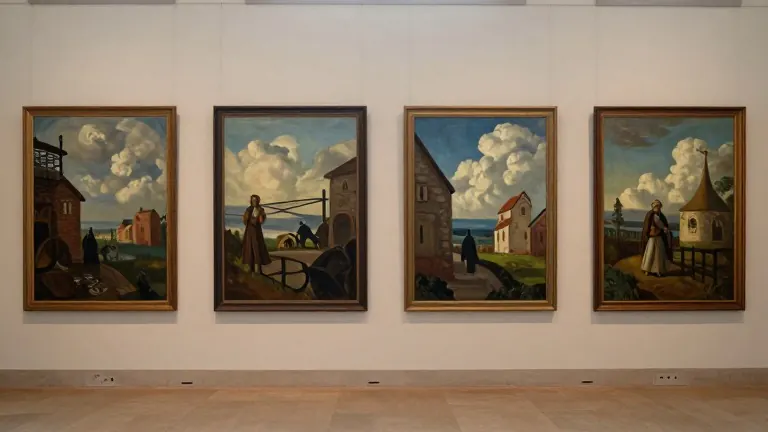
Four large oil paintings on the north wall of the Laramie Plains Civic Center have prompted a review of local history. The panels, created in 1929, depict a romanticized version of the Wyoming frontier. A building manager has publicly questioned the accuracy of the imagery, specifically noting how the paintings portray Indigenous people.
The artworks were commissioned by Wilbur A. Hitchcock, the architect for the building's 1929 addition. Florence Ware, a Salt Lake City artist and granddaughter of Laramie pioneers, painted the scenes. The building was originally East Side School, the first brick schoolhouse in Wyoming Territory. It opened in 1978, the same year Northern Arapaho people arrived by Army escort to what is now the Wind River Reservation.
The murals show settlers in hoop skirts waving at steam engines and children playing with bows and arrows. Men with dogs rest on prairie hills while cattle move in the background. Historic figures such as Jim Bridger, Jacques La Ramie, Father DeSmet, and Chief Washakie appear throughout the landscape. However, the most debated scene shows a group of Indigenous figures in feather headdresses floating in a pink cumulus cloud.
In that specific panel, the figures ascend from the prairie to the sky. One man stands while the others sit in a half circle. The building manager describes the scene as depicting a peaceful gift of land to settlers. This imagery presents Indigenous people as passive witnesses to the creation of Wyoming, rather than active participants in its history.
Dawn Stagner, an enrolled member of the Cheyenne Arapaho Tribe and Eastern Shoshone, wrote a reflection for America's 250th anniversary this summer. She noted that the government made traditional ceremonies illegal and that boarding schools attempted to strip Indigenous people of their languages. Stagner stated that equality did not exist for her people in Wyoming.
Chief Washakie is celebrated across the state as a peacemaker. The 1863 Treaty of Fort Bridger granted the Eastern Shoshone approximately 44 million acres. By 1868, a second treaty reduced that land to roughly 3 million acres in the Wind River Valley. Ware told the Laramie Boomerang in 1969 that she painted the scenes as a historical record. She researched the area for months to include as much history as possible.
The building's National Register of Historic Places nomination describes it as bringing formal education to frontier children. University of Wyoming President Dr. A.G. Crane dedicated the building in 1928, dedicating it to truth, knowledge, and the posterity of Laramie. The manager now serves as the steward of this space and the story the paintings tell.
Scholars Eve Tuck and K. Wayne Yang wrote that decolonization returns Indigenous land. They argued that the process decenters settlers entirely. The manager notes that tools of community building, such as storytelling and philanthropy, are not innocent of this history. The painted figures represent living communities, not just distant memories.
Stagner wrote that true equality demands a hard look at the past. The manager plans to continue examining the murals and the stories they tell. The paintings remain on the north wall of the civic center for visitors to see.
More News · Cheyenne news · Report a business · Got a Story?