US Expands Efforts To Disrupt Iran's Supply Routes Beyond Naval Blockade
A new US military task force is taking aim at Iran's land borders and Caspian Sea trade, but analysts say its impact may be limited without regional cooperation.
By News Media House Staff ·
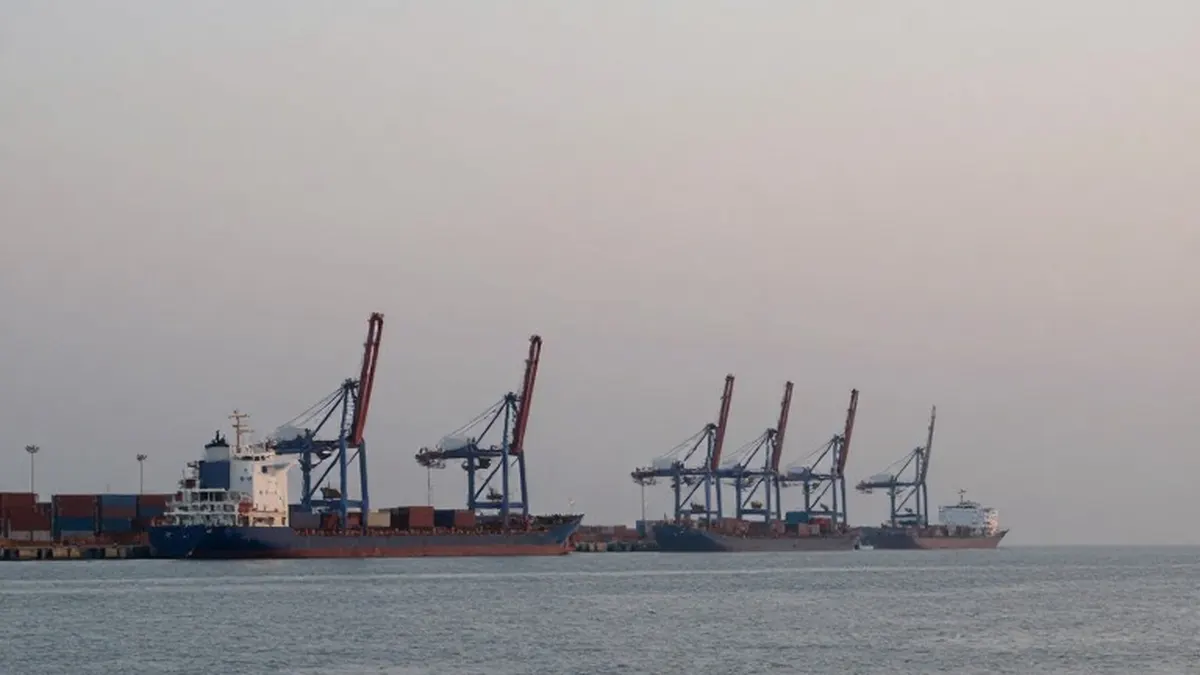
The US military is broadening its campaign to disrupt Iran's supply networks, looking beyond the naval blockade of Iranian ports to the country's land borders and the Caspian Sea.
On November 7, US Central Command announced the creation of Task Force Iron Gate, an internal team of roughly 20 civilian and military personnel based in Tampa, Florida. According to the CENTCOM statement, the unit will coordinate with other US government agencies to stop Iran from moving advanced weapons systems, dual-use technologies, sanctioned materials, and what Washington describes as illegal revenue streams across its land borders and the Caspian.
The task force is meant to reinforce a naval blockade that CENTCOM estimates has already prevented Iran from exporting more than $25 billion worth of crude oil. Even so, Iran continues to obtain military-related equipment despite Western sanctions. A recent Reuters investigation found that Iran used a network of military-linked agencies to import at least $2 billion in hardware, explosives, and heavy-duty trucks between January 2025 and June 2026, with goods arriving on cargo ships crossing the Caspian from Russia, trucks from Central Asia, and freight aircraft from China.
Analysts who spoke to RFE/RL said Task Force Iron Gate could improve intelligence-sharing and help identify companies and intermediaries involved in Iran's procurement networks. But they questioned whether the initiative can meaningfully restrict the flow of goods without cooperation from regional governments.
Farzin Nadimi, a senior fellow with The Washington Institute, told RFE/RL's Radio Farda that the task force appears designed to bring together US agencies already monitoring sanctions and collecting intelligence. He said naval restrictions have made it harder for Iran to obtain materials for its defense industries, particularly its missile program, from China, but land transport, railways, and Caspian shipping through Russia could still carry some components, including electronic parts used in drone production, though in smaller quantities and at higher cost. "Nothing can replace maritime transport because of its enormous capacity," Nadimi said. He cautioned that the task force's creation did not necessarily signal an intent to use military force against suspect vehicles or shipments, though he did not rule out covert operations.
Nahid Jafarov, an Azerbaijani political expert and former diplomat, said the task force's practical impact could be limited, with its main function likely confined to collecting information. He suggested the initiative could also serve as a tool for Washington to pressure Tehran and strengthen its position in negotiations. RFE/RL has contacted the US Treasury Department for comment.
The Caspian Sea presents a particular challenge for Washington. The sea is enclosed by Iran, Russia, Azerbaijan, Kazakhstan, and Turkmenistan, leaving the United States without direct territorial access. Ahmad Alili, head of the Caucasus Political Analysis Center, said the Caspian has become an increasingly important corridor for Iranian commercial goods, energy products, and raw materials. The route has also faced allegations that Russia and Iran use it to transfer military equipment, though such shipments remain difficult to independently verify.
Amir Chahaki, a Europe-based international affairs analyst, told Radio Farda that Washington could not effectively restrict Iran's northern supply routes without accounting for Moscow. "It is inconceivable that ships traveling from Russia to Iran could be attacked or targeted by drones. That would mean a direct war with Russia," he said, adding that he expects the United States to focus instead on expanding sanctions against companies and logistics operators cooperating with Iran. The Caspian's importance has grown as Tehran and Moscow develop alternative trade links, including the International North-South Transport Corridor. The number of active Russian- and Iranian-flagged vessels operating in the Caspian rose 21 percent year on year in August, according to Lloyd's List Intelligence, though that increase does not necessarily indicate a corresponding rise in military shipments. The route also faces capacity constraints, including shallow waters, limited port infrastructure, and rail bottlenecks.
Washington would also need cooperation from countries along Iran's land borders, whose ties with Tehran vary widely. Iraq, one of Iran's largest cross-border trading partners, has so far refused a US request to close all but two of its border crossings, according to Iraqi officials cited by Ynetnews, and Baghdad depends on Iran for more than a third of its natural gas supply.
Pakistan, which shares a roughly 900-kilometer border with Iran, has moved to curb bilateral trade. On October 16, its Commerce Ministry withdrew an October 3 extension of a temporary waiver of the Electronic Import Form requirement for imports from Iran, and on October 17 it suspended commercial trade through two key crossings, leaving about 2,000 trucks stranded, according to the Quetta Chamber of Commerce and Industry. But a Pakistani official told RFE/RL on condition of anonymity that trade continued unofficially, with traders still importing Iranian liquefied petroleum gas and other goods through informal arrangements. RFE/RL could not independently verify the official's account.
Originally published by News Media House