300,000 Overnight Stays Expected as Atacama Desert Blooms
Heavy rains triggered by El Niño have awakened millions of dormant seeds, creating the largest floral display in the arid region in three decades.
By Simon Bennett ·
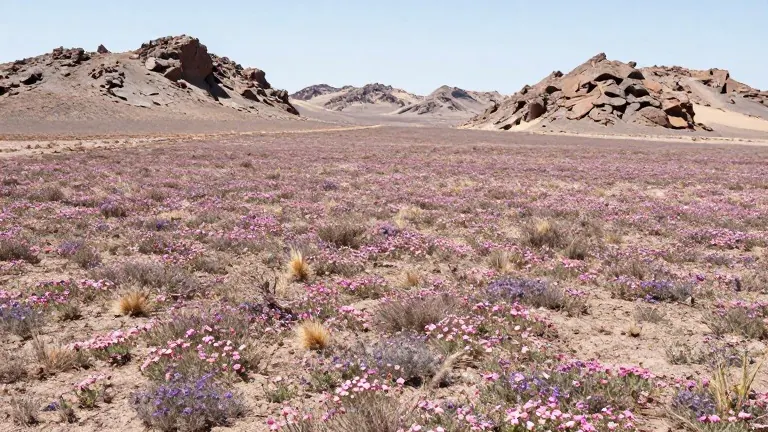
The Atacama Desert in Chile is currently hosting its largest floral bloom in 30 years, drawing a surge of visitors to the arid landscape. Officials in the Atacama region expect approximately 300,000 overnight trips over the next two months as the flowers peak. The phenomenon, driven by heavy rains, has transformed the typically dry terrain into a colorful expanse of pinks, yellows, and purples.
The bloom follows a period of intense weather activity. El Niño conditions brought flash floods to the desert in July and August. These floods damaged dozens of homes and forced hundreds of residents to evacuate. However, the rainwater penetrated deep into the soil, activating millions of seeds, bulbs, and tubers that had remained dormant under the sand for decades.
Moisés Grimberg, administrator of Llanos de Challe National Park, describes the event as a race against time. He notes that the biological window for these species to complete their life cycle lasts only two to three months. More than 200 plant species are currently in flower. Scientists have observed blooms in areas where flowers had never been previously recorded, suggesting that some bulbs had lain dormant since before 1997, when the phenomenon was first studied in detail.
Tourism numbers have risen sharply in response to the display. Llanos de Challe National Park, which spans 113,000 acres along the coastline, typically receives about 10,000 visitors per year. In the last few weeks alone, 15,000 tourists have visited the site. Roads across the desert are lined with vehicles from visitors. Among the most popular attractions is the garra de león, a crimson flower with flame-like green leaves that grows only on this specific stretch of the Atacama coastline.
Researchers from INIA, Chile's national seed bank, are collecting specimens to analyze in their laboratories. Ana Sandoval, a biologist with the group, is working to preserve genetic material and study the unique adaptations plants have developed for survival. She explains that the desert is not empty but waiting for the right precipitation to awaken its ecosystem. The bloom supports a transient web of life, including insects, lizards, bats, and guanacos.
The Atacama region is in the process of seeking UNESCO World Heritage recognition for the bloom. Miguel Vargas, the regional governor, stated that this status would diversify the local economy, which is currently heavily reliant on mining. He aims to have the site designated within a couple of years, making it Chile's eighth World Heritage site. A dedicated national park was created in June 2023 to protect a 141,000-acre area where these flowers spring up.
This year's bloom is projected to last until mid-November. The event occurs every few years in what is the driest nonpolar desert on Earth. Climate changes are bringing unseasonal rains, and scientists say the phenomenon is becoming more frequent. As the flowers begin to fade, scientists will examine the specimens to determine if this was the largest flowering event on record and whether any previously unknown species are present.
More News · Cheyenne news · Report a business · Got a Story?