Lander woman logs 10 minutes in freezing Popo Agie River
Felicity Hnilicka recruits neighbors to join her winter river jumps while UW scientist explains the body's physiological response to ice water.
By Alyssa Parker ·
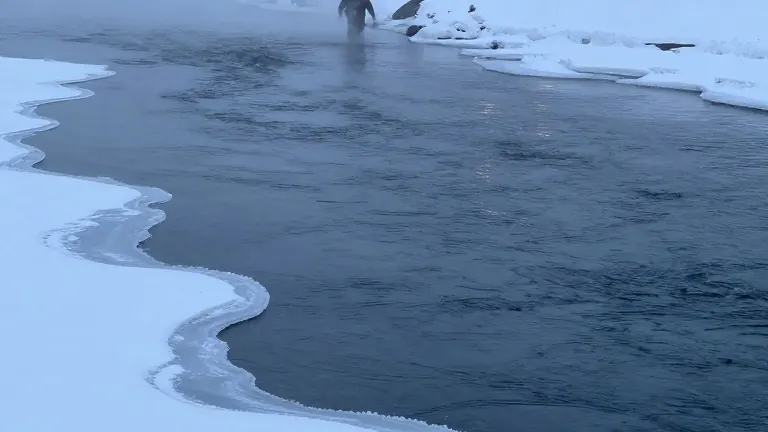
Felicity Hnilicka is recruiting Lander residents to jump into the Popo Agie River with her this winter. The 24-year-old resident aims to complete her first full season of cold plunges, a practice she has attempted for three years but never finished.
Hnilicka usually takes her plunge at the City Park bridge near McManus. She began this habit in February 2024, when the air temperature was 16 degrees and she and friends entered the river before skiing. She said the water was brutally cold and her wet feet stuck to the rocks on the way out.
She now spends between five and 10 minutes in the river as the season progresses. Hnilicka, a former personal trainer, said the cold exposure improves her sleep, circulation, and stress management. She keeps her car running with a warm towel and hot tea ready for after the plunge.
"A lot of the time I don't want to do it. My body doesn't want to get into the water," Hnilicka said. She added that overcoming that resistance helps her avoid procrastination in daily tasks like answering emails.
Kimberly Coats, who lives on a 600-acre ranch near Savery in Carbon County, also practices cold plunging. In January or February, she and her husband chopped a hole in the ice of Savery Creek and entered water that was 32 degrees while the air temperature hovered around 20 degrees.
Coats described the experience as a rush, noting a tingling sensation that made her feel incredibly awake. However, her doctor advised her to stop the practice in spring due to a medical diagnosis unrelated to the cold exposure. She still enjoys snowshoeing in 15 to 20-degree temperatures.
Ward Dobbs, an assistant professor of kinesiology and health at the University of Wyoming, explained the physiological effects of icy water. He said the body's immediate reaction is a powerful stress response where the heart rate accelerates and breathing becomes rapid. Submerging the face in cold water can trigger a reflex that slows the heart, creating what is known as cardiovascular conflict.
Dobbs noted that flowing river water carries away heat more rapidly than still water because it prevents a warm layer from forming around the skin. This increased convection means the body loses heat faster, which can interfere with muscle function and coordination over time. He said that even trained swimmers can struggle to climb out after prolonged exposure.
Dobbs compared the adaptation process to becoming accustomed to exercising in hot weather. He said that repeated exposure allows the body to adapt to the stress, similar to how people in Finland use saunas and cold lake plunges to alternate between extreme temperatures. He cautioned that while the practice can be beneficial, too much cold exposure can be as bad as not enough.
More News · Cheyenne news · Report a business · Got a Story?