
Buffalo's Abandoned Castle Has Industrial Roots
The structure near Clear Creek was a hydroelectric plant built to protect the town's power supply after a 1912 flood.
By Alyssa Parker ·
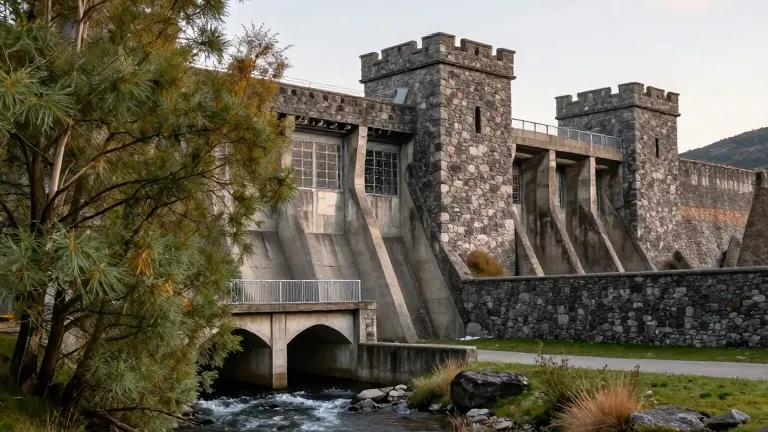
Residents of Buffalo, Wyoming, often pass a medieval-style structure near Clear Creek that appears to be an abandoned castle. The building, located west of Buffalo, was not built for defense or leisure. It was a functional hydroelectric plant designed in the early 20th century to protect the town's water infrastructure from flooding. The castle-like exterior was a deliberate choice by the financier who commissioned the work.
The site has a long history tied to milling and power. George Beck built the original flour mill in 1882 on the same ground where John Fischer had previously built a brewery. Beck planned for the future by securing land rights for electric power generation. In 1899, H.P. Rothwell bought the mill and incorporated it into the Buffalo Manufacturing Company. Rothwell electrified the mill in 1900, using the water power Beck had established. This made Buffalo one of the first communities west of the Mississippi River to have electricity.
The original mill suffered heavy damage during a flood of Clear Creek in 1912. The water destroyed $50,000 worth of stored flour. Marshall Bell, the electrical manager, had to climb through a window to escape the rising water. Rothwell decided to rebuild the infrastructure with stronger protections. He hired local contractor Leonard Burger to build a new hydroelectric plant in 1914. The new construction included a dam on the creek and a tall concrete retaining wall. These features gave the building its fortress appearance.
The plant operated 24 hours a day to meet the town's growing energy demand. Bell managed the equipment until the 1920s. The flour mill next to the plant suffered a severe fire in March 1920. Firefighters struggled to put out the blaze due to freezing temperatures that turned their water into ice. The fire destroyed most of the mill building but left the dynamo intact. Rothwell rebuilt the mill using insurance money, but the business struggled during the 1919 economic recession. He sold the hydroelectric plant to Mountain State Power Company in 1927. The company converted the site to diesel power, ending the original water-driven system's 46-year run.
Rothwell sold the mill and closed the Buffalo Manufacturing Company in 1933. He remained in Buffalo until his death on May 11, 1940. The remains of the flour mill were demolished in the 1970s after its foundations collapsed. The home built for Bell was burned in 1990 during a fire drill by the Buffalo Volunteer Fire Department. The castle-like power plant structure remains standing today. It is the only major physical remnant of the early industrial complex along Clear Creek.
Charles Vance Lucas, a Buffalo resident, documented the history of the mill in 1970. He described the pioneers who built the infrastructure as visionaries. They anticipated the community's growth and built systems that served the town for decades. The castle now stands as a historical relic among cottonwood trees. The trees were originally watered with water from the plant, which was sold for 25 cents a barrel in the early 1900s. The structure marks the same spot where Fort McKinney once stood before the Army abandoned it in 1894.
More News · Cheyenne news · Report a business · Got a Story?