Delhi air quality hits 'very unhealthy' as PM2.5 levels spike to 157.9
Residents and experts say the capital’s recurring winter smog crisis stems from a lack of year-round regional coordination and reactive government measures.
By Simon Bennett ·
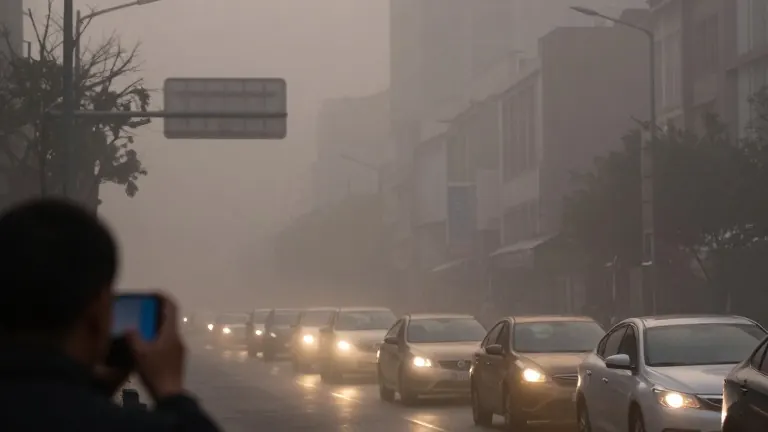
Delhi’s winter air quality has deteriorated to a level that public health officials classify as hazardous for all residents, marking the latest cycle in an annual pattern of environmental distress.
On Thursday, the city’s average concentration of fine particulate matter, known as PM2.5, reached 157.9 micrograms per cubic meter. This figure places the air in the 'very unhealthy' category according to the Swiss air quality monitoring firm IQAir. The World Health Organization recommends an annual limit of no more than 5 micrograms per cubic meter for safe exposure.
The current smog event follows a predictable seasonal trajectory that has defined the past several winters in the National Capital Region. As temperatures drop, pollution levels rise, prompting emergency restrictions and public complaints. Government agencies often point to external factors, while residents report physical symptoms such as headaches, eye irritation, and dry throats. Khushboo Arora, a resident, described waking up with a heavy head and a parched throat. She has stopped exercising outdoors and installed air purifiers to protect her mother, who has underlying health conditions.
Experts argue that the city’s problems extend beyond its administrative borders. Sunil Dahiya, founder of the environmental group EnviroCatalysts, noted that Delhi operates within a larger airshed where regional dynamics dictate local air quality. Analysis of government Decision Support System data from the previous winter indicated that approximately 65% of Delhi’s PM2.5 originated from outside the city limits. Neighboring districts such as Noida and Gurugram were identified as major contributors. Dahiya stated that coordinating action across the region, which spans multiple state jurisdictions, remains a structural obstacle.
A 2026 assessment by an expert panel reviewed by the Delhi government identified the primary winter sources of pollution. These include vehicular emissions, industrial activity, road and construction dust, and the burning of biomass and waste. Dahiya pointed to a gap between scientific recommendations and government implementation. He said scientists have advised airshed-wide, year-round interventions for over a decade, but authorities have largely relied on seasonal, reactive measures. These temporary fixes often include water sprinklers and smog towers, which provide limited relief compared to structural changes like cleaner fuels and expanded public transport.
Political blame has intensified as the air quality worsened. Delhi Environment Minister Manjinder Singh Sirsa attributed the rising pollution to stubble burning in the neighboring state of Punjab. He claimed that local sources such as construction, vehicles, and industry were under control. Dahiya acknowledged that crop burning in Punjab and Haryana is a sharp, episodic contributor that can rapidly degrade air quality. However, he noted that vehicles alone account for roughly 51% to 53% of local PM2.5 within Delhi. He added that secondary particulates formed from industrial and transport gases also play a major role. Dahiya observed that even if stubble burning ceased entirely, Delhi would likely remain in unhealthy air categories for much of the year.
Bhavreen Kandhari, co-founder of Warrior Moms, criticized the government’s reliance on cleanup operations after pollution events. She described the use of water sprinklers and cloud seeding as photo opportunities that waste public funds. Kandhari also highlighted the issue of waste incineration, arguing that it exacerbates the problem compared to proper waste management. Several Delhi government officials did not respond to requests for comment on the current air quality data.
Residents with lower incomes face the highest health risks because they often cannot afford personal air purification devices. Deepika, a domestic worker in South Delhi, reported a week-long cough and stated that she must endure the pollution for several months. Namrata Yadav, a mother of eight, participated in anti-pollution protests in November of the previous year. She said the lack of progress is exhausting. Yadav stated that residents have learned to live with pollution, but now demand that authorities take steps to end it.
The city faces a choice between continuing seasonal emergency plans or adopting a sustained clean-air strategy. Experts and residents agree that year-round control, better inter-governmental coordination, and stronger enforcement of regulations are necessary to break the cycle.