Israelis Vote in Tight Election Shaped by Security Failures and Fears for Democracy
Polls show Benjamin Netanyahu and former military chief Gadi Eisenkot in a near dead heat, with neither bloc expected to reach the 61 seats needed for a majority.
By News Media House Staff ·
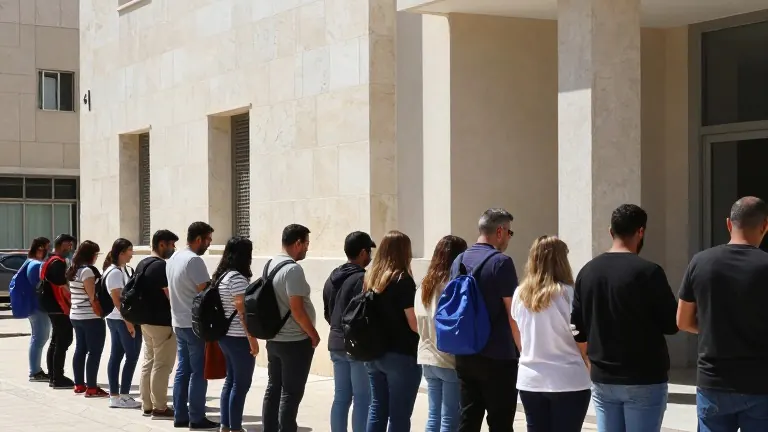
Israelis are voting in an election widely seen as one of the most consequential in the country's history. Polling released on Friday put incumbent Prime Minister Benjamin Netanyahu almost level with Gadi Eisenkot, a former military chief, in the contest for the premiership.
Neither man's political bloc is projected to win the 61 seats required to form a majority government. That raises the prospect of weeks or months of negotiations before a coalition emerges. Israel's proportional representation system has always produced coalition governments, and the process has sometimes thrown up unexpected alliances.
Security has dominated the campaign. The opposition has attacked Netanyahu over the failures that preceded the 7 October Hamas-led attacks, in which nearly 1,200 people were killed and 251 were taken to Gaza as hostages. Opposition parties want an independent commission of inquiry, which Netanyahu has long resisted, arguing it would be biased against him. He has instead cast himself again as "Mr Security", citing what he describes as strategic victories in Israel's wars across the Middle East and his close ties with US President Donald Trump.
Eisenkot leads the newly formed Yashar Party and is the central figure in a so-called "change bloc" of parties that disagree ideologically but share the aim of removing Netanyahu. The bloc includes former prime minister Naftali Bennett and Avigdor Lieberman, both right-wingers with hardline security positions, as well as Yair Golan, a left-leaning former general. Netanyahu, who first became prime minister in 1996, needs to rebuild his alliance with the far-right and ultra-Orthodox parties of his current coalition, the most right-wing in Israel's history.
Critics also point to alleged threats to democracy. Netanyahu is on trial on corruption charges, which he denies, and continues to pursue contentious judicial reforms that sparked mass protests before 7 October. The question of conscripting ultra-Orthodox men in full-time religious study has also loomed large, after the government failed to enforce a Supreme Court ruling requiring it. In the final days of the race, Israel's Channel 12 reported that Netanyahu pushed for military action that could have triggered a confrontation with Iran before the vote, but was opposed by military chief Eyal Zamir. CNN reported he also sought new US strikes on Iran, which Trump declined to approve. Netanyahu denied both reports. He also posted an AI-generated image of a nuclear bomb striking Tel Aviv, which Eisenkot called "hysterical".
On Gaza, Eisenkot's stance is broadly similar to Netanyahu's. He has pledged to end Hamas rule in the territory within 18 months, through a US-led peace plan or by military means if needed. Israel has struck Gaza almost daily since last year's ceasefire, saying it targets Hamas operatives. Gaza's Hamas-run health ministry, whose figures the UN considers reliable, says more than 74,000 people have been killed since the war began. Eisenkot largely backs settlements in the occupied West Bank but wants action against extremist settlers, whose attacks are at a record high according to UN figures. The two-state solution has all but vanished from mainstream Israeli politics.
About one-fifth of Israelis are Arab, and two Arab party blocs are running. In theory they could become kingmakers, but all but one of the leading Jewish parties have ruled out working with them. Some have speculated they might informally prop up an Eisenkot-led minority government, though Lieberman has ruled out joining such an arrangement.
A reported 70,000 people have flown home from abroad to vote, and hundreds of thousands are casting ballots for the first time. Israeli broadcasters will publish exit polls at 22:00 (20:00 GMT) on Tuesday, though these can vary significantly from final results. Votes from soldiers and reservists will largely not be counted until Wednesday, which could give a late lift to right-wing parties believed to be popular with that group.
Although the race is often framed as a duel between Netanyahu and Eisenkot, another party leader could take the top job by withholding support for a coalition unless given it. Many fear a deadlock in which no bloc reaches a majority and no minority government can be formed. New elections would then be called, with Netanyahu staying on as interim prime minister. Israel held five separate elections between 2019 and 2022 as parties repeatedly failed to cooperate.
Originally published by News Media House · Source: BBC News