Pope Leo XIV Takes to the Skies for 12-Flight South American Tour
The pontiff begins his longest trip yet in Uruguay, his first overseas visit following lung cancer surgery.
By Alyssa Parker ·
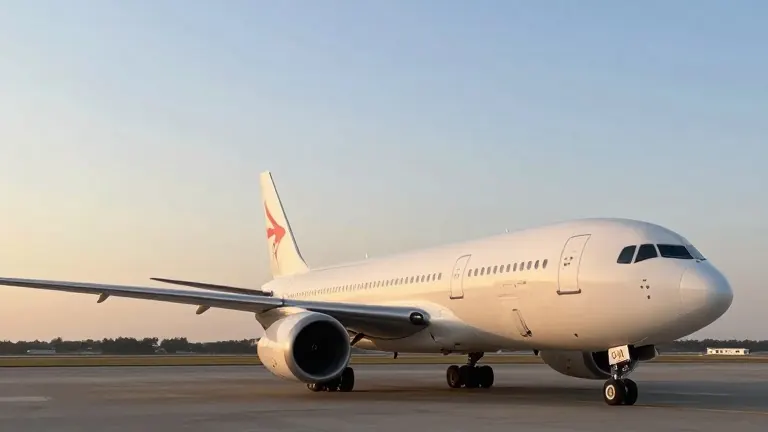
Pope Leo XIV landed in Montevideo, Uruguay, on Thursday morning to begin a 12-day itinerary that spans three nations. The journey marks his first major overseas trip since undergoing surgery to remove the lower lobe of his right lung last month. Vatican officials confirm the 69-year-old pontiff has completed his two-week recovery period and requires no further treatment.
The scale of the operation is substantial. Leo will board 12 planes and two helicopters during the trip. He is scheduled to deliver 36 speeches across 10 cities. One stop, Cusco, Peru, sits at an elevation of more than 11,000 feet. Altitude sickness is a common risk for travelers at that height, often requiring supplemental oxygen.
Maria Montserrat Alvar, the Vatican’s communications chief, said the pope is eager to start. She noted that his doctors are confident in his health and that medical staff will be on board for every leg of the journey. "His doctors are very confident and he'll have plenty of medical care on board should something happen," Alvar said.
Uruguay serves as the initial destination, a choice that surprises some observers. The nation of 3.5 million people is known as Latin America’s most secular country. It has separated religion from government for over a century. Christmas is officially Family Day, and Easter week is called Tourism Week. Only about a third of citizens identify as Catholic, and fewer practice the faith, according to Mariana Pomiés, director of polling firm CIFRA.
Despite the secular culture, local believers are preparing for the visit. In the Pocitos neighborhood, a large banner depicting a waving Leo hangs on the Blessed Sacrament Church. Ana Maria Saprissa, a 70-year-old retiree, said she is thankful for the attention. "His visit gives us such joy because …he remembered us all here in this tiny country that has so many needs," Saprissa said.
Pomiés, a practicing Catholic, argued that Uruguayan officials often misunderstand secularism. She explained that the state’s neutrality in religious matters has become an absolute in local perception. "Secularism is not anti-religion, it's the neutrality of the state in religious matters. But here the neutrality se convirtió en un absoluto… it became an absolute," Pomiés said.
The pope will celebrate evening prayers at Montevideo’s main cathedral before moving to Florida, about an hour from the capital, for Sunday mass. The town commemorates the Virgin of the Thirty-five on Nov. 8, a date tied to Uruguay’s independence from the Brazilian empire in 1825. Leo is also scheduled to visit the Casavalle neighborhood, a working-class area where volunteers cleaned streets and built a stage outside the Our Lady of Guadalupe Church.
Father Pablo Coimbra, who has led the community for six years, said the visit centers a population that often lives on the margins. "For the first time many people live their lives always on the margins, on the margins of opportunities, of possibilities, of the future, on the margins of a loving gaze.. well, today they are in the heart, in the center," Coimbra said.
Leo will move to Argentina by Sunday, fulfilling a wish of his predecessor, Pope Francis. Francis had hoped to return to his homeland but never made the trip. The visit offers a test of how Leo will navigate tensions with right-wing leaders. President Javier Milei’s austerity measures have pushed millions into poverty, a point of friction with a pope who champions the poor. Milei also supports aggressive artificial intelligence development, while Leo’s recent encyclical called for ethical safeguards.
The trip concludes with a return to Peru, where Leo served as a missionary and bishop for two decades. He became a naturalized Peruvian in 2015 and has stated the country shaped his life. He will meet President Keiko Fujimori, daughter of former dictator Alberto Fujimori. Leo was critical of military violence during the Fujimori era and supported the Truth and Reconciliation Commission. In Montevideo, Juan Martin Guerreiro said he is giving Leo a chance because he is South American, though he notes the new pope feels less influential than Francis.
More News · Cheyenne news · Report a business · Got a Story?