Serbia's Student List begins government formation talks after landslide win
The leaderless movement secured 53% of the vote to end Aleksandar Vučić's 14-year rule and faces a 90-day deadline to form a cabinet.
By Simon Bennett ·
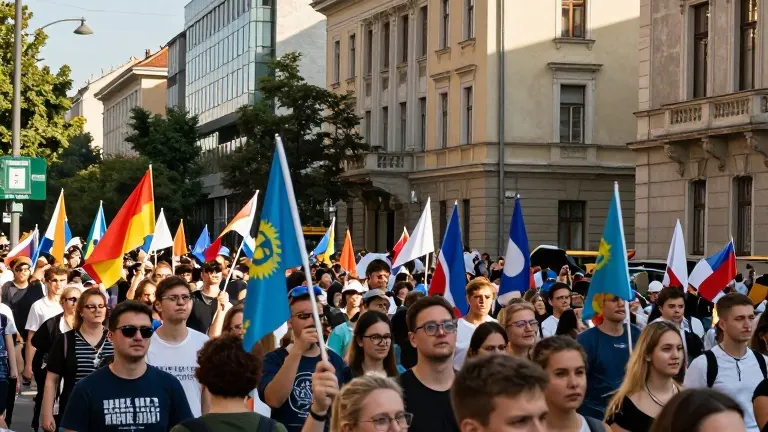
Serbia's Student List movement has moved to start negotiations for forming a new government following a decisive election victory on Sunday. The group, which lacks a single figurehead, captured 53 percent of the vote in the parliamentary election. This result grants the movement 141 seats in the 250-seat parliament. The win marks the end of the political dominance of former president Aleksandar Vučić, who conceded defeat late Sunday evening.
The political shift follows two years of sustained public protest. The demonstrations began after a canopy collapsed at the Novi Sad railway station, killing 16 people. Vučić ruled Serbia for 14 years, a period characterized by control over media, judiciary, and state institutions. His Serbian Progressive party won 39 percent of the vote, securing 103 seats. The remaining seats went to national minority lists.
The Student List operates without a formal hierarchy. Its candidate roster includes academics, actors, farmers, and students. Ilija Srdanović, a cardiologist, headed the list. Dejan Šoškić, a former central bank governor, and Radomir Saičić, a chemistry professor at Belgrade University, are also prominent figures. Saičić spoke on behalf of the group after the victory. The movement has not yet named a prime minister or cabinet members.
Ana Mirković, a university educationist and candidate, described the group's approach to power. She stated that the victory is not about gaining privileges but about taking on a historic debt to the people and their children. Mirković told The Guardian that the first priority is the social and psychological detoxification of the country. She said the new government would dismantle a system of intimidation that encouraged fear and polarization.
The movement's platform focuses on fighting corruption and restoring the rule of law. Key proposals include creating an independent police unit accountable to prosecutors rather than the interior ministry. The plan also calls for a purge of police officers linked to organized crime. The group aims to ban party loyalists from appointments in state-owned companies. New independent bodies would oversee major state infrastructure contracts to ensure financial accountability.
Mirković said the government would urgently open up the media and stop institutional violence. She added that the goal is to rebuild society from the ground up. This includes full disclosure of all contracts and financial flows, depoliticizing the judiciary, and renewing education and healthcare systems. The group stated that state capture should never again be possible.
The movement kept foreign policy issues, such as relations with the EU and Russia, in the background during the campaign. The Kremlin expressed hope on Monday that new leaders understand cooperation with Russia is in Serbia's interests. Analyst Dušan Vučićević noted that the movement insisted on addressing domestic political issues first. He said the focus is on dismantling institutions from the national to the local level.
Nikola Burazer, programme director at the Belgrade-based Centre for Contemporary Politics, said the movement's decision-making process needs to be sped up. He noted that choosing candidates took months. Burazer said that after the initial celebration, attention will turn to how the government will look. He remarked that 24 hours ago, the formation of such a government seemed like a fantasy.
Vučić blamed his defeat on direct support from European countries and the US. He cited the US deep state as a factor against President Trump. International leaders welcomed the result. Ukrainian President Volodymyr Zelenskyy called it a new chapter in the country's history. German Chancellor Friedrich Merz said Berlin would actively support Serbia's European path. Merz noted that the students' demand for rule of law reached the people.
Serbia's constitution requires the new parliament to convene within 30 days of the official election result. A 90-day deadline follows for the formation of the new government. The country must hold new presidential elections before December 27. This is because Vučić stepped down to run for prime minister.
Source: The Guardian