Large Bull Moose Protects Orphaned Calf Near Gros Ventre Campground
A massive bull in Grand Teton National Park is acting as a guardian to a weaned calf, a rare bonding that may help the young animal survive the coming winter.
By Alyssa Parker ·
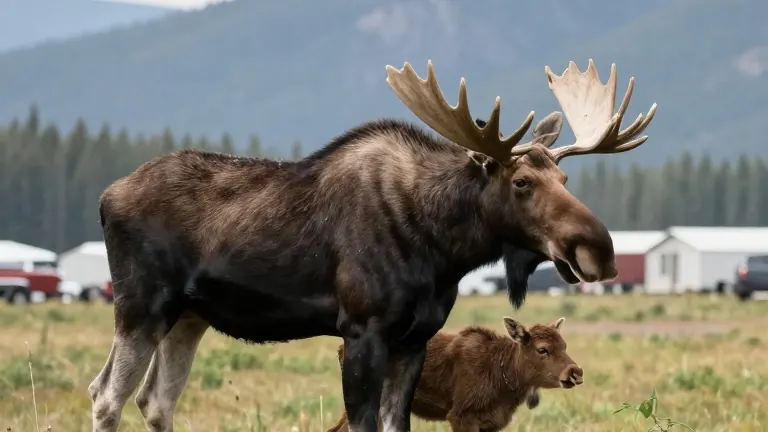
A massive bull moose in Grand Teton National Park is serving as a protective figure for an orphaned calf, a relationship that park observers say is unusual but potentially beneficial. The pair has been spotted near the Gros Ventre Campground, where the young moose follows the large male closely, staying within a few yards of him at all times.
Wildlife photographer Tim O’Leary first observed the pair during a recent visit to the park. He noted that while the bull is tolerant of the calf, the dynamic changes when the young moose attempts to nurse. “The bull wouldn’t really kick it hard, but it would try to nudge it away,” O’Leary said. The calf appears to have been weaned from milk but still seeks the physical contact associated with nursing.
Jonathan Raetzman, a wildlife watcher, confirmed seeing the duo and described the calf’s behavior as similar to that of a puppy dog. The calf consistently chooses the large bull over other moose in the area. O’Leary witnessed a smaller bull walking near the pair. When the calf ran to catch up, it consistently moved toward the larger bull rather than the smaller one. O’Leary noted that the calf seemed to treat the big bull as a mother figure.
Biologist Kevin Monteith, a researcher with the Haub School of Environment and Natural Resources at the University of Wyoming, described the bonding as fairly strange. In typical wildlife scenarios, orphaned calves are often adopted by other female moose or temporarily cared for by them. Monteith pointed to a 2024 incident in Yellowstone where a female grizzly was found with five cubs, suggesting some were adopted. However, for a male to take on this role is highly unusual.
Despite the rarity, Monteith believes the arrangement improves the calf’s chances of survival as winter approaches. Having an adult animal nearby provides protection and guidance. Monteith stated that nutritionally, the calf can function off forage just fine at this stage. “It just misses out on the learning it could gain from Mum,” he said. He added that the calf looks healthy and is in good shape.
Photographer Savannah Rose also observed the orphaned calf floating around the area. She noted that the calf was no longer dependent on cow’s milk but was still attempting to nurse from at least one bull. Rose expressed optimism about the calf’s chances of making it through the season, provided it no longer requires milk for nutrition. Raetzman and O’Leary both confirmed seeing the calf eating forage, which is a positive indicator of its health.
The identity of the bull remains uncertain. It is not yet counted among the named moose of the Tetons, such as Hoback, Bondurant, or Fremont. O’Leary believes he may have photographed the same bull during his visits last year. While the calf’s mother is missing, Raetzman ruled out the poached cow moose with a research collar found near Dubois as the biological mother. The bull and calf continue to move together near the campground.
The pair’s presence has drawn attention from visitors and researchers alike. The calf’s attachment to the bull appears firm, and the large male’s size offers a distinct advantage in the rugged terrain. As the seasons change, the survival of the orphaned calf will depend on its ability to maintain its foraging habits and stay close to its unlikely guardian.
More News · Cheyenne news · Report a business · Got a Story?